For a broad retail checkout, TRC20 is usually the practical default because many customers and exchanges support it. It is not the cheapest in every case: a USDT transfer can cost 6.4–13 TRX without TRON resources, while Solana starts at 0.000005 SOL, TON quotes about 0.001 TON, BNB Smart Chain about $0.005, and Ethereum cost depends on gas.
USDT is one dollar-linked asset issued or represented on several blockchains. A merchant therefore chooses more than a ticker: each enabled network changes customer reach, network-fee handling, confirmation rules, reconciliation and the recovery path for payment mistakes.
What network is USDT on?
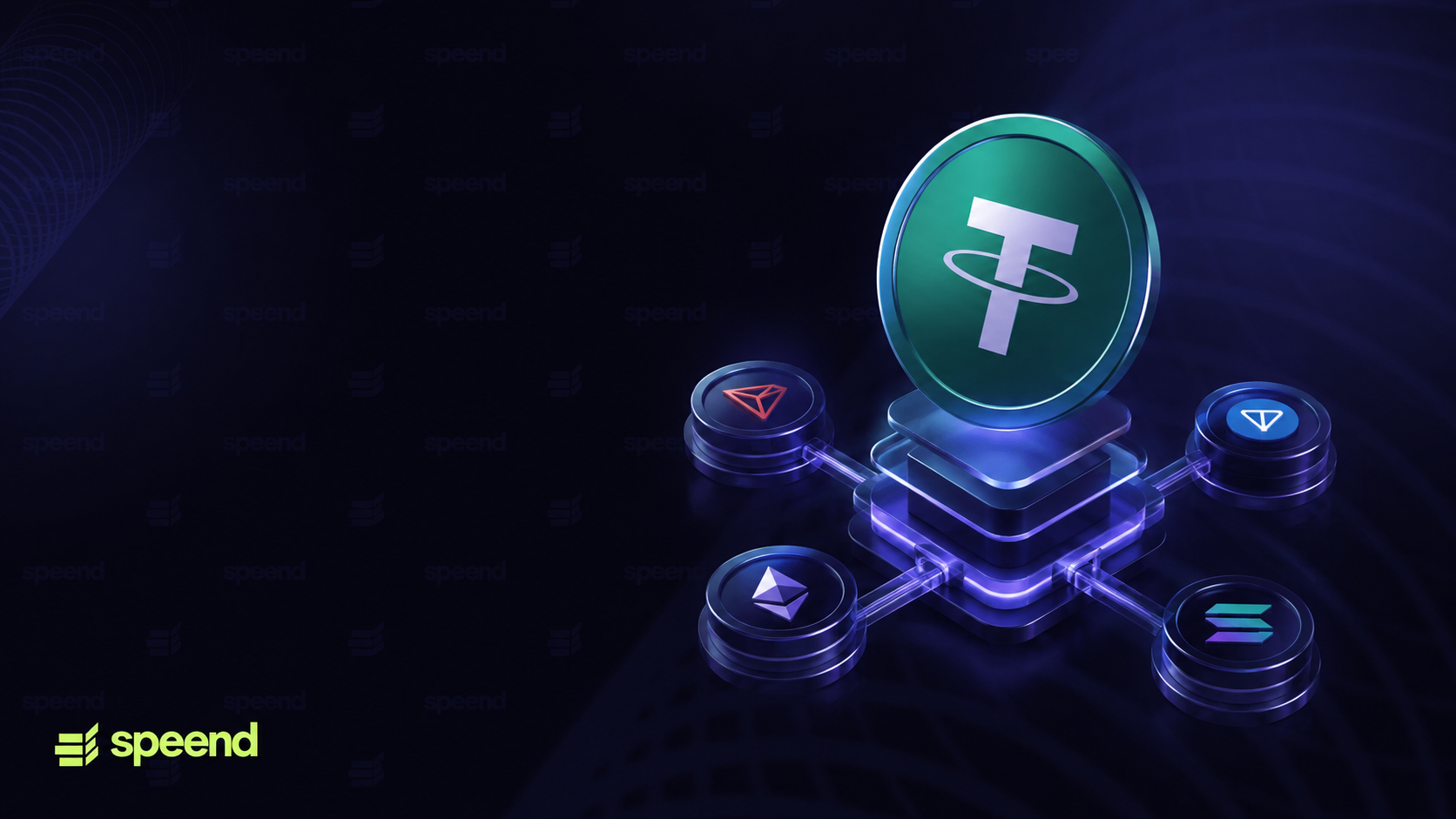
USDT is on multiple networks, not one universal chain. Tether lists native USDt contracts on Ethereum, TRON, Solana and TON, among other protocols. On BNB Smart Chain, the token commonly displayed as “USDT” may instead be Binance-Peg BSC-USD, so its contract and issuer model require a separate check.
This answers what network is USDT on, what network does USDT use, and what chain is USDT on: the correct rail is the one selected by both sender and recipient. At checkout, USDT should include the chain name, chain-specific address, accepted contract and confirmation policy.
Tether’s Q1 2026 attestation reported $183.438 billion of issued digital tokens as of March 31, 2026. That total covers all supported protocols, not one blockchain.
Why the same USDT exists on different networks
The same USDT exists on different networks because unrelated blockchains keep separate ledgers. Tether deploys or authorizes a contract on each supported protocol. A bridge or exchange can move economic value between rails, but it does not make an Ethereum address compatible with TRON, Solana or TON.
For a payer, the difference appears as a network selector and a fee paid in TRX, ETH, SOL or TON. For a merchant, each rail creates separate deposit monitoring, confirmation, refund and reconciliation states.
USDT can be ERC-20 on Ethereum, but USDT as a whole is not limited to ERC-20. Tether ERC20 is Tether’s Ethereum deployment. What is Tether ERC20? It is Tether’s Ethereum deployment. What is USDC ERC20? It is Circle’s USDC contract on Ethereum. The answer to is USDC ERC20 is therefore yes for the Ethereum version, although Circle also issues USDC on other chains. USDT and USDC remain separate assets with different issuers and contracts.
CoinLaw estimates that stablecoins account for about 82% of crypto payments across gateways in 2026. It is a directional secondary estimate rather than an audited gateway dataset, but it shows why stablecoin routing deserves more attention than a generic coin list.
TRC20 USDT on TRON
TRC20 USDT is the largest retail-facing USDT rail here by holder count. TRONSCAN showed about 75.3 million holder addresses and roughly 90.3 billion USDT on TRON on July 31, 2026. Broad exchange support and familiar T... addresses make it a practical default for international consumer payments.
The official contract is TR7NHqjeKQxGTCi8q8ZY4pL8otSzgjLj6t.
Fees and speed
A TRC20 transfer does not have a fixed dollar fee. TRON charges smart-contract execution through Energy and bytes through Bandwidth. Accounts receive 600 free Bandwidth points daily; staked or delegated TRX can supply more Bandwidth and Energy.
At the documented burn prices, a typical transfer uses about 64,000 Energy when the recipient already holds USDT and around 130,000 when the recipient has no USDT balance:
- 64,000 × 0.0001 TRX = 6.4 TRX;
- 130,000 × 0.0001 TRX = 13 TRX;
- roughly 300 bytes can add about 0.3 TRX without free or staked Bandwidth.
At TRONSCAN’s displayed price of about $0.326 on July 31, the model equals roughly $2.19–$4.34 without enough resources. With sufficient resources, the amount burned can approach zero. Exchange withdrawal fees are separate.
TRON blocks arrive about every three seconds. TRONSCAN displayed around 205 observed TPS and a recent maximum near 1,035 TPS at the snapshot; a gateway may wait for more than one block before crediting an invoice.
When TRC20 is the right choice
TRC20 fits broad exchange-connected audiences and managed payouts where the operator controls Energy. It is weaker for micro-orders when payers burn TRX, or for customers already native to Ethereum, Solana or TON. The trade-off is adoption versus protocol cost.
Merchants planning to accept TRON payments should test both recipient states because the first transfer to an empty USDT address can consume about twice the Energy of a transfer to an active one.
ERC20 USDT on Ethereum
ERC20 USDT is Tether’s native token on Ethereum and a strong option for Ethereum wallets, institutional custody and DeFi-connected users. Etherscan counted about 15.36 million holder addresses on July 31, 2026. The main checkout drawback is variable gas.
The official contract is 0xdAC17F958D2ee523a2206206994597C13D831ec7. Ethereum addresses start with 0x, and the fee is paid in ETH.
Assume a plain USDT transfer uses 65,000 gas. At Etherscan’s July 31 snapshot of 0.2 gwei, the charge is 0.000013 ETH; at the previous day’s 2.229 gwei average, it is 0.000144885 ETH. Congestion and exchange withdrawal markups can raise the payer’s cost.
Ethereum produces a block about every 12 seconds and handles roughly 15–20 Layer-1 TPS. Detection can happen after one block, while gateway confirmation and protocol finality take longer.
ERC20 suits higher-value B2B and treasury flows whose funds already sit on Ethereum. It is less attractive for low-ticket checkout when gas becomes material. Merchants can accept Ethereum payments beside a lower-cost rail.
USDT on Solana
USDT on Solana is an SPL token suited to low-cost, frequent payments from Solana-native wallets. The official explorer showed about 3,578 total TPS at the July 31 snapshot. Its base fee is 5,000 lamports per signature, or 0.000005 SOL, before an optional priority fee.
Bitget Wallet showed about 2.07 million token-holder accounts for the mint on July 31; this is a secondary explorer figure, and token accounts are not necessarily unique people. The official mint is Es9vMFrzaCERmJfrF4H2FYD4KCoNkY11McCe8BenwNYB. Solana uses Base58 addresses. A first receipt may also require an associated token account, adding a one-time setup cost.
Confirmation is commonly sub-second to a few seconds, depending on commitment and RPC quality. Public Solana RPC endpoints are rate-limited and not intended for production, so merchant reliability depends on dedicated infrastructure.
Solana fits games, digital goods and trading products with many small payments, provided customers already hold the token there. Merchants can accept Solana payments without forcing users to bridge.
USDT on TON
USDT on TON is a Jetton for users inside the TON and Telegram ecosystem. TON quotes about 0.001 TON for a USDt transfer, approximately 0.4-second blocks and about 0.6-second finality. Its 100,000+ TPS figure comes from a public test, not observed merchant throughput.
TON Viewer showed about 3.36 million holders and roughly 1.43 billion USDt issued on July 31. The official master contract is EQCxE6mUtQJKFnGfaROTKOt1lZbDiiX1kCixRv7Nw2Id_sDs. User-friendly addresses commonly begin with EQ or UQ; a custodian may also require a memo or comment.
TON fits Telegram mini apps and creator products. It should not replace TRC20 by assumption: the payer’s exchange must offer TON withdrawals for that account and region.
BEP20 and the rest
BEP20 is inexpensive and EVM-compatible, but “USDT on BNB Smart Chain” requires an issuer check. BNB Chain quotes typical fees around $0.005 or less and a block time near 0.45 seconds. The widely used 0x55d398326f99059fF775485246999027B3197955 contract is Binance-Peg BSC-USD, not native USDt listed by Tether. BscScan displayed about 60 million holder addresses for it on July 31, 2026.
A gateway should allowlist the contract rather than trust the ticker. Other rails, including Arbitrum, Optimism, Polygon, Avalanche and USDT0 deployments, can reach specific audiences. Adding every rail still creates more monitoring and recovery paths.
USDT networks compared: fees, speed and support
The networks differ most in user distribution, fee asset and operational handling. These are dated network mechanics or snapshots; wallet and exchange charges can be higher.
Want to accept crypto payments on your website?
Fast setup and KYC/KYB, fee starts from 0.5%
Contact Us- TRON / TRC20: 0 with enough resources, otherwise about 6.4–13 TRX plus Bandwidth; about three seconds to a block; 75.3 million holder addresses and about 205 observed TPS on July 31. Best for broad exchange-connected retail.
- Ethereum / ERC20: gas used × gas price; a 65,000-gas model costs 0.000013 ETH at 0.2 gwei; about 12 seconds per block and 15–20 L1 TPS. Best for Ethereum-native and higher-value flows.
- Solana / SPL: 0.000005 SOL base per signature plus optional priority and account creation; usually sub-second to a few seconds; about 2.07 million token-holder accounts and 3,578 total TPS at the snapshot. Best for frequent small payments.
- TON / Jetton: about 0.001 TON per USDt transfer; roughly 0.6-second finality; about 3.36 million holders. Best for TON and Telegram users.
- BNB Smart Chain / BEP20: about $0.005 or less; roughly 0.45-second blocks; about 60 million holder addresses for Binance-Peg BSC-USD on July 31. Verify the exact supported contract.
Holder counts are not unique-user counts: one person may control several addresses, while one exchange address may represent many customers.
Which USDT networks should a merchant accept?
A merchant should accept the smallest set that covers most payer demand, then add rails when transaction data supports them. For many international stores, TRC20 plus one audience-specific alternative is a clearer launch set than five equal USDT buttons.
Average order value: low-ticket products need a fee that remains small relative to the basket. Solana, TON or BSC can work when customers already use them. Ethereum is easier to justify for larger invoices; TRC20 depends on payer resources and exchange fees.
Customer geography and wallets: use failed selections, support requests and withdrawal options. TRC20 often covers international exchange users, TON can matter for Telegram-led acquisition, Solana fits Web3 audiences, and Ethereum reaches EVM-native and institutional customers.
Payment frequency: repeated top-ups magnify payer cost. High-frequency businesses should route users toward a rail they already hold. For occasional high-value invoices, compatibility may outweigh a few dollars of gas.
The USDT payment gateway decision is network coverage plus routing, not the number of logos shown.
What it costs to support several networks at once
Supporting five USDT networks multiplies controls even when one gateway exposes them through one API. Each rail needs deposit detection, a contract allowlist, confirmation rules, native-fee handling, a refund route and an RPC or explorer fallback. Five networks create 30 chain-specific control points under this six-control planning model; one creates six.
Assume 1,000 USDT payments per month, a 0.5% network-exception rate and 45 minutes per investigation. That equals five cases and 3.75 support hours before recovery, compensation or finance review. These are transparent planning assumptions, not an industry benchmark.
Refund gas and treasury balances also fragment across chains. A gateway can normalize webhooks and settlement but cannot erase blockchain differences. Speend supports 300+ cryptocurrencies across 18 networks, letting a merchant enable selected rails in one integration rather than build every watcher directly.
What happens if a customer pays on the wrong network
A wrong-network payment does not move to the intended chain, and the transfer cannot be reversed. Recovery depends on who controls the destination address on the chain actually used, whether the token contract is genuine, and whether the receiver supports manual access.
When the funds are recoverable
Recovery may be possible between EVM-compatible chains when the same 0x address is controlled by the recipient. The operator may access the address on the actual chain, add the correct contract and return or manually credit the token. A custodian may also recover funds through its own process.
When they are not
Funds may be lost when no one controls the destination on the actual chain, the token reached an unsupported contract, a required custodial memo was omitted, or the address is unrelated. TRON, Solana, TON and Ethereum do not share one address space.
Tether limits recovery to specific circumstances and tells users to contact the receiving party first. A merchant should not promise recovery before custody, chain and contract are verified.
How a gateway prevents this at checkout
A gateway should bind one invoice to one chain and contract, display the full network name, use a chain-specific QR code and monitor only the expected asset.
For an incident, collect the transaction hash, actual chain, token contract, sender, intended invoice and withdrawal screenshot. Do not issue a second refund until the transfer is located and ownership is confirmed. Manual credit or return should follow compliance and reconciliation controls.
How to check a USDT address and a transaction
Check the network before checking the balance. A valid-looking address can belong to the wrong chain, and a copied ticker can point to a counterfeit contract.
- Read the network selected in the wallet or exchange.
- Compare the format:
T...for TRON,0x...for Ethereum or BSC, Base58 for Solana,EQ...orUQ...for TON. - Verify the contract against Tether or the gateway allowlist.
- Open the transaction hash in the correct explorer and check status, recipient, contract and amount.
- Match it to the invoice and wait for the gateway’s required confirmation state.
An explorer proves on-chain activity, not the off-chain identity of an address owner.
FAQ
What network is USDT on?
USDT runs on several blockchains, including Ethereum, TRON, Solana and TON. Sender and recipient must use the same network and contract.
Which USDT network has the lowest fees?
Solana, TON and BNB Smart Chain usually have the lowest protocol fees here. Exchange withdrawal charges and TRON resources can change the payer’s result.
Is USDT ERC20 the same as USDT TRC20?
They represent Tether on different ledgers. They are separate tokens and their addresses are not interchangeable.
What happens if I send USDT on the wrong network?
Automatic credit may fail. Recovery depends on control of the destination on the actual chain and the receiver’s policy; some errors are permanent.
Which USDT network do exchanges support?
Support varies by exchange, region, account and maintenance status. Check the live withdrawal screen before each transfer.
Can a merchant accept USDT on several networks at once?
Yes. A multi-network USDT payment gateway can issue chain-specific details and normalize notifications while the merchant controls the visible rails.
How long does a USDT transfer take on each network?
Initial inclusion is about three seconds on TRON, 12 seconds per Ethereum block, often sub-second to a few seconds on Solana, around 0.6 seconds to finality on TON, and about 0.45 seconds per BSC block. Merchant credit can take longer.
How do I check a USDT wallet address before sending?
Confirm the chain, address format and official contract. A small test transfer reduces exposure but does not replace those checks.
Why does my USDT transfer cost more on Ethereum?
Ethereum charges gas in ETH, and the gas price changes with demand. The token amount does not directly set the fee.
Which network should a business accept for USDT payments?
Start with the rail most customers already use. Add another for a measurable audience segment, then expand only when conversion data covers the operational cost.
Accept USDT on supported networks with Speend
Speend’s USDT page currently lists TRON, Ethereum, BNB Smart Chain, Polygon and Solana. The platform supports more than 300 cryptocurrencies across 18 blockchain networks overall. Merchants can choose the USDT rails that fit their audience and avoid building a separate watcher for each chain.
Start with setting up crypto payments. Coverage should follow customer demand, order value and support capacity.
Sources and data notes
- Tether Q1 2026 attestation and official contracts.
- TRONSCAN, TRON burn rates, USDT Energy examples and Stake 2.0.
- Ethereum blocks, L1 throughput and gas.
- Solana fees, explorer, USDT holder data and RPC guidance.
- TON metrics, TON Viewer, BNB Smart Chain, BscScan token data, wrong-chain recovery and Tether recovery policy.
- Circle USDC networks, CoinLaw gateway estimate and Speend supported coins.